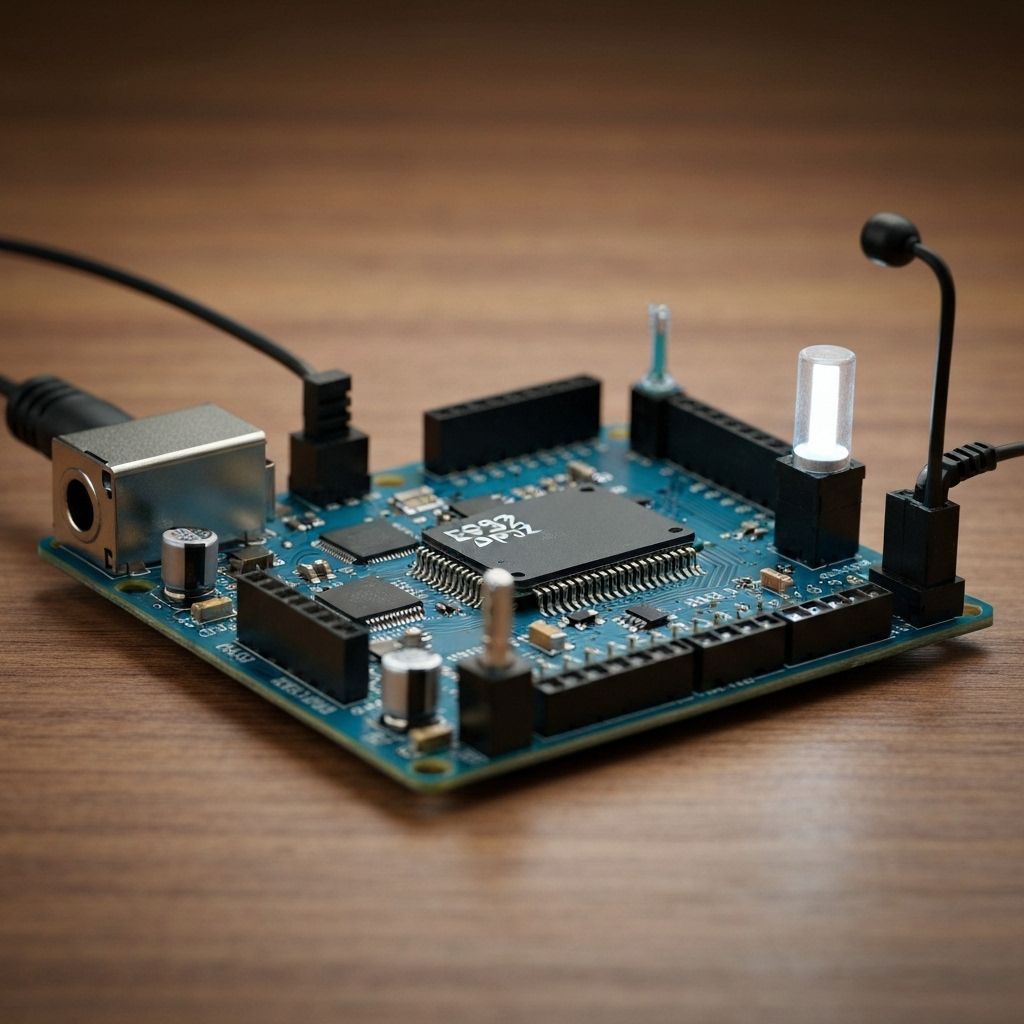
Custom ARM Cortex-M Bootloader Development for Secure OTA Updates
Learn to develop a secure bootloader for ARM Cortex-M microcontrollers with encrypted firmware updates, rollback protection, and fail-safe recovery mechanisms.

Custom ARM Cortex-M Bootloader Development for Secure OTA Updates
Over-the-air (OTA) updates are essential for modern IoT devices, but they introduce significant security risks. This guide covers building a production-ready secure bootloader for ARM Cortex-M processors with cryptographic verification and fail-safe recovery.
Bootloader Architecture Overview
Memory Layout Design
// Memory map for STM32F4 with 1MB Flash
#define BOOTLOADER_BASE         0x08000000  // 64KB bootloader
#define APPLICATION_BASE        0x08010000  // 448KB application
#define DOWNLOAD_BASE           0x08080000  // 448KB download area
#define CONFIG_BASE             0x080F0000  // 64KB configuration
Dual-Bank Architecture
typedef struct {
    uint32_t magic;           // 0xDEADBEEF
    uint32_t version;         // Semantic versioning
    uint32_t size;            // Firmware size in bytes
    uint32_t crc32;           // CRC32 checksum
    uint8_t signature[64];    // ECDSA signature
    uint8_t hash[32];         // SHA-256 hash
    uint32_t boot_attempts;   // Rollback counter
    uint32_t flags;           // Status flags
} __attribute__((packed)) firmware_header_t;
Cryptographic Security Implementation
ECDSA Signature Verification
#include "mbedtls/ecdsa.h"
#include "mbedtls/sha256.h"

bool verify_firmware_signature(const firmware_header_t *header,
                               const uint8_t *firmware_data,
                               uint32_t firmware_size) {
    mbedtls_pk_context pk;
    unsigned char hash[32];

    // Parse public key and calculate SHA-256 hash
    mbedtls_pk_parse_public_key(&pk, public_key_pem, sizeof(public_key_pem));

    mbedtls_sha256(firmware_data, firmware_size, hash, 0);

    // Verify ECDSA signature
    int result = mbedtls_pk_verify(&pk, MBEDTLS_MD_SHA256, hash, sizeof(hash),
                                  header->signature, sizeof(header->signature));

    mbedtls_pk_free(&pk);
    return (result == 0);
}
Flash Management and Wear Leveling
Sector-Based Flash Operations
#include "stm32f4xx_hal_flash.h"

typedef enum {
    FLASH_OK,
    FLASH_ERROR_PROGRAM,
    FLASH_ERROR_WRP,
    FLASH_TIMEOUT_ERROR
} flash_status_t;

flash_status_t flash_write_data(uint32_t address, const uint8_t *data, uint32_t size) {
    HAL_StatusTypeDef status = HAL_OK;

    // Verify alignment (STM32F4 requires word alignment)
    if ((address % 4) != 0 || (size % 4) != 0) {
        return FLASH_ERROR_PROGRAM;
    }

    HAL_FLASH_Unlock();

    // Program in 32-bit words
    for (uint32_t i = 0; i < size; i += 4) {
        uint32_t word_data = *(uint32_t*)(data + i);
        status = HAL_FLASH_Program(FLASH_TYPEPROGRAM_WORD, address + i, word_data);

        if (status != HAL_OK) break;
    }

    HAL_FLASH_Lock();
    return (status == HAL_OK) ? FLASH_OK : FLASH_ERROR_PROGRAM;
}
Bootloader State Machine
Boot Process Flow
typedef enum {
    BOOT_STATE_INIT,
    BOOT_STATE_VALIDATE_PRIMARY,
    BOOT_STATE_UPDATE_AVAILABLE,
    BOOT_STATE_PERFORM_UPDATE,
    BOOT_STATE_LAUNCH_APP,
    BOOT_STATE_RECOVERY,
    BOOT_STATE_ERROR
} boot_state_t;

bool validate_firmware(firmware_header_t *header, uint32_t base_address) {
    // Check magic number
    if (header->magic != 0xDEADBEEF) return false;

    // Validate size
    if (header->size > APPLICATION_SIZE || header->size < 1024) return false;

    // Calculate and verify CRC32
    uint32_t calculated_crc = calculate_crc32(
        (uint8_t*)(base_address + sizeof(firmware_header_t)),
        header->size
    );

    if (calculated_crc != header->crc32) return false;

    // Verify cryptographic signature
    return verify_firmware_signature(header,
                                   (uint8_t*)(base_address + sizeof(firmware_header_t)),
                                   header->size);
}
Application Launch and Vector Table Management
Safe Application Launch
typedef void (*application_entry_t)(void);

bool jump_to_application(uint32_t app_address) {
    uint32_t app_stack_ptr = *((uint32_t*)app_address);
    application_entry_t app_entry = (application_entry_t)*((uint32_t*)(app_address + 4));

    // Validate stack pointer and entry point
    if (app_stack_ptr < 0x20000000 || app_stack_ptr > 0x20030000) return false;
    if ((uint32_t)app_entry < app_address || ((uint32_t)app_entry & 0x01) == 0) return false;

    // Disable interrupts and deinitialize peripherals
    __disable_irq();
    deinitialize_bootloader_peripherals();

    // Relocate vector table and jump to application
    SCB->VTOR = app_address;
    __set_MSP(app_stack_ptr);
    app_entry();

    return false; // Should never reach here
}
Recovery Mode and Communication
UART Recovery Protocol
typedef enum {
    CMD_PING = 0x01,
    CMD_GET_INFO = 0x02,
    CMD_ERASE_FLASH = 0x03,
    CMD_WRITE_FLASH = 0x04,
    CMD_LAUNCH_APP = 0x06
} recovery_command_t;

void enter_recovery_mode(void) {
    initialize_recovery_uart();
    send_recovery_announcement();

    while (1) {
        recovery_packet_t packet;
        if (receive_recovery_packet(&packet, 5000)) {
            if (validate_recovery_packet(&packet)) {
                handle_recovery_command(&packet);
            }
        }

        HAL_IWDG_Refresh(&hiwdg); // Prevent watchdog reset
    }
}
Security Hardening
Write Protection and Anti-Rollback
void configure_flash_protection(void) {
    FLASH_OBProgramInitTypeDef ob_init;

    // Configure write protection for bootloader sectors
    ob_init.OptionType = OPTIONBYTE_WRP;
    ob_init.WRPState = OB_WRPSTATE_ENABLE;
    ob_init.WRPSector = OB_WRP_SECTOR_0 | OB_WRP_SECTOR_1;

    // Configure read protection
    ob_init.OptionType |= OPTIONBYTE_RDP;
    ob_init.RDPLevel = OB_RDP_LEVEL_1;

    HAL_FLASHEx_OBProgram(&ob_init);
    HAL_FLASH_OB_Launch(); // Apply changes
}

bool is_version_allowed(uint32_t new_version) {
    uint32_t highest_version = get_highest_recorded_version();
    return (new_version >= highest_version); // Prevent rollback
}
Production Deployment Considerations
Manufacturing Support
typedef struct {
    uint32_t serial_number;
    uint8_t mac_address[6];
    uint8_t aes_key[32];
    uint8_t device_certificate[512];
} device_provisioning_t;

bool program_device_provisioning(const device_provisioning_t *provisioning) {
    if (unlock_configuration_area()) {
        bool success = write_provisioning_data(CONFIG_BASE, provisioning);
        lock_configuration_area();
        return success;
    }
    return false;
}
Conclusion
Building a secure bootloader for ARM Cortex-M devices requires careful attention to:
- Security: Cryptographic validation, secure boot chain, anti-rollback
- Reliability: Dual-bank updates, automatic rollback, recovery mode
- Performance: Fast boot times, efficient flash operations
This bootloader design provides:
- Cryptographically signed firmware updates
- Fail-safe recovery mechanisms
- Production-ready security features
- Field-updateable operation
Key Benefits:
- Zero-downtime updates with automatic rollback
- Strong security against malicious firmware
- Recovery from corrupt updates
- Suitable for safety-critical applications
The complete implementation enables secure, reliable OTA updates essential for modern IoT deployments.

Manish Bookreader
Electronics enthusiast, Embedded Systems Expert, Linux/Networking programmer, and Software Engineer passionate about AI, electronics, books, and cooking.